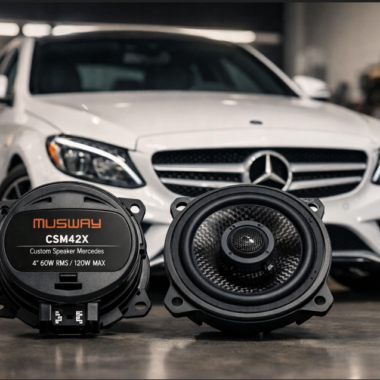



Have you ever spent a small fortune on a brand-new set of Focal speakers or a high-end Helix amplifier, only to be disappointed when you finally hit the road? It’s a frustrating experience. You’re parked in your driveway, and the music sounds crisp and punchy. But as soon as you hit 60 mph on the A421, the bass disappears, the vocals get buried, and everything sounds… thin.
What’s going on? It isn’t your gear; it’s your car. Your car is essentially a hollow metal box on wheels, and it is the absolute worst environment for high-fidelity audio. Between the wind whistling past the mirrors, the roar of the tyres on the tarmac, and the vibration of the engine, your music is fighting a losing battle against road noise. At Apex Automotive Customs, we believe that trying to build a great audio system without sound deadening is like trying to paint a masterpiece on a vibrating canvas.
Why Expensive Speakers Aren’t Enough
A common mistake I see is people thinking they can just “power through” the noise by buying louder speakers. But here is the thing: if your car’s interior is noisy, your brain has to work harder to separate the music from the background racket. This leads to “listener fatigue,” where you find yourself constantly turning the volume up, yet never feeling satisfied with the sound.
Expensive speakers are precision instruments. They are designed to reproduce delicate nuances and sharp transients. If your door panels are vibrating in sympathy with your mid-bass drivers, those vibrations create “cancellation.” The energy that should be reaching your ears is instead being wasted on shaking the metal skin of your door. To get the most out of top-tier brands like JL Audio or Musway, you need to fix the environment first.
The Physics of the Moving Door Panel
Think about how a speaker works. It has a cone that moves back and forth to push air. For that cone to work efficiently, it needs a solid, stationary surface to push against. But in a standard car door, the speaker is mounted to a thin sheet of vibrating metal.
When the speaker cone moves forward, the door panel often moves backward. This is a classic case of physics working against you. It’s like trying to jump off a trampoline versus jumping off a concrete floor. You lose all your “spring.” This results in weak, muddy mid-bass. Sound deadening stops that metal from flexing, turning your door into a rigid, sealed enclosure, essentially a high-quality speaker cabinet.
What is Sound Deadening Anyway
When we talk about sound deadening, we aren’t just talking about one single product. It is a multi-stage process designed to tackle different types of noise. It isn’t just about making the car quieter; it’s about controlled acoustics.
At Apex Automotive Customs in Bedford, we treat sound deadening as a strategic military operation against noise. We use different materials to handle different frequencies, ensuring that the only thing vibrating in your car is the air moving from your speakers to your ears.
The Three Layers of Silence
A professional sound treatment usually involves three distinct types of materials, each with its own specific job. If you skip one, you’re leaving performance on the table.
Vibration Damping Butyl Mats
This is the most common layer. You’ve probably seen these, they usually look like silver or black foil-backed rubber sheets. These mats are made of butyl rubber, and their job is to add “mass” to the thin metal panels. By making the metal heavier and less prone to vibration, you stop the “ringing” sound. If you tap on a treated door, it sounds like a solid thud instead of a hollow “ting.”
Closed Cell Foam for Decoupling
Once the vibration is under control, we move to the second layer: Closed Cell Foam (CCF). This layer doesn’t necessarily block noise, but it acts as a “decoupler.” It prevents your plastic interior trim panels from rubbing against the metal door skin. It’s like a soft cushion that stops the squeaks and rattles that happen when you’re driving over rough roads or playing bass-heavy music.
Mass Loaded Vinyl The Ultimate Barrier
The “big guns” of sound treatment is Mass Loaded Vinyl (MLV). This is a very dense, heavy material that actually blocks airborne noise. While butyl mats stop vibrations, MLV stops the sound of the car next to you and the road noise from entering the cabin. It’s like replacing a thin glass window with a thick brick wall.
Improving Mid-Bass Response and Punch
If you want that “kick in the chest” feeling from your mid-bass drivers, sound deadening is non-negotiable. When we seal the holes in the inner door skin and stiffen the panel, we create a much better acoustic environment for the speaker.
The difference is night and day. Suddenly, your 6.5-inch door speakers start sounding like they’ve gained an extra inch in size. The bass becomes tighter, more defined, and far more impactful. You stop hearing the door “buzz” and start hearing the actual drum notes.
Eliminating the Infamous Rattles and Squeaks
We’ve all had that one annoying rattle in the passenger door that only happens at a certain volume or a certain RPM. It drives you crazy, doesn’t it? Sound deadening is the ultimate cure. By treating the door cards and the mounting surfaces, we eliminate the parasitic noises that distract from the music. It makes the car feel more premium, more solid, and significantly more expensive than it actually is.
Lowering the Noise Floor for Greater Detail
In audio, the “noise floor” is the level of background noise present in a system. If your road noise is high, you lose the “micro-details” in your music, the subtle breath of a singer, the ring of a cymbal, or the acoustic space of a live recording.
By lowering the noise floor through sound treatment, you don’t have to play your music as loud to hear those details. This is the secret to a high-end “audiophile” experience in a car. It allows the true quality of your amplifiers and speakers to shine through.
The Thermal Bonus Keeping Your Cabin Comfortable
Here is a benefit most people don’t expect: sound deadening materials are also fantastic thermal insulators. Because they add mass and create a barrier, they help keep the heat out in the summer and the warmth in during the winter. This means your air conditioning and heater don’t have to work as hard, making the car a much more pleasant place to be, regardless of the audio.
Transforming Your Car into a High-End Listening Room
Our goal at Apex is to turn your vehicle into a sanctuary. When you step inside, the world should disappear. A properly treated car has a “silent” quality to it, a vault-like feel that you usually only find in top-tier luxury vehicles like a Mercedes S-Class or a Rolls-Royce. We can bring that level of refinement to almost any vehicle, providing the perfect foundation for a custom audio build.
Why Professional Application Matters
Can you do it yourself? Sure. But it is a messy, time-consuming job that requires a lot of specialized tools and knowledge. You need to know exactly where to apply the material to get the most benefit without adding unnecessary weight. You also need to ensure that the material doesn’t interfere with the movement of windows, door handles, or side-impact sensors.
Our team in Bedford has years of experience in stripping interiors and applying these treatments flawlessly. We use high-quality rollers to ensure a 100% bond with the metal, because if there are air gaps, the material won’t work properly.
The Apex Automotive Approach to Sound Treatment
We don’t believe in a “cookie-cutter” approach. Every car is different. A van needs a different treatment than a convertible or a compact hatchback. We assess the “weak points” of your vehicle, whether it’s the wheel arches, the boot floor, or the outer door skins, and apply the right mix of materials to solve the problem.
We often recommend sound deadening as the very first step of any audio project. Even if you’re keeping your factory speakers for a while, a well-treated door will make them sound 20% better instantly. It is the best bang-for-your-buck upgrade in the car audio world.
Final Words
If you are chasing the perfect sound, stop looking at wattage and start looking at your doors. Sound deadening isn’t the most “glamorous” part of a car audio build, it isn’t shiny, and you can’t see it once the panels are back on, but it is arguably the most important. It is the foundation that allows every other component to perform at its peak. Don’t let road noise steal your joy. Come see us at Apex Automotive Customs, and let’s build you a system that sounds as good on the motorway as it does in the driveway.